Phone aaya, phone aaya! – Part 2: Winds of change (mid-1980s – mid 1990s)

Winds of change started blowing in the mid-80s with the first PM of India who grew up post-independence. The erstwhile PMs, having grown up before India gained independence from the British, were wary of forging close business relationship with companies based out of India. Understandable as the English gained entry into India as the innocuous East India Company only to stay entrenched and colonize the country 😦 The scars were deep and fresh for those who witnessed or took part in the struggle to gain freedom. What that resulted in was building a manufacturing base within and creating educational institutions (to supply engineers and workers) for reducing outside dependence. That provided a measure of self-reliance. Challenge was in taking it to the next level. The new PM, unencumbered by such burden of history and being exposed to technology advances when studying abroad, realized the need to open up for modernization of communication systems. The Government of the day decided it was not their business to decide who should own what and began by deregulating a bit. Return of tech-savvy folks who had worked and made a name for themselves abroad aided this quest to improve. With focused effort the wait for a residential telephone reduced drastically to single digit years! If you paid a higher deposit money the wait could be shaved off by couple of years too. With more pay phones targeted for installation mom and pop stores could also make some money on the side by managing pay phones installed outside their shops.
With the introduction of H1 visa by the USA, to attract more tech trained folks, the # of Indians traveling to the land of opportunity increased significantly. In the USA – Ma Bell, which had been ruling the roost for the better part of 20th century, attracted the attention of the regulators. A private monopoly, which is not good either, they were stymieing competition and were free to charge as they pleased as long as there was no viable competition. I clearly remember how steep the calling rates were for international calls especially as I was personal witness to that. My brother was in the USA for higher studies and a good chunk of the stipend he got for his TA was spent in calls to family back in India. While we had applied for a telephone it was still a few years away from being delivered. Every weekend he would make a call to a neighbor and by the time we reached their place few minutes later for speaking to him AT&T folks were already laughing all their way to the bank to the tune of ~ $2.50/minute 😦
We got our own phone connection in due course of time and along with new handset that my brother had sent with touch buttons, message and other nice features. It was an occasion to celebrate! Those were the days caller ID, call waiting etc were not widely available. The obligatory calls to friends, relatives and co-workers followed along with request to them to make a note of our telephone#. Calls from work or other places outside to home just to keep the phone running like a well oiled machine 😀 It was fun to call those initial days just because we could 🙂 Of course new developments in voice technology were about to make their presence felt and they were just around the corner: The cellular technology and the mobile phone!

Part 3: I am mobile and I am here to stay!…To be continued

Phone aaya, phone aaya! – Part1 (mid 1970s – mid 1980s)

This is the age of ubiquitous smartphones. Carrying one on person has become almost as essential as breathing. Not too long ago having a telephone was not considered necessary. Back in the 1970s and early 80s in the India I grew up in very few homes had landline phones. Phones were something that belonged to the workplace primarily and very few homes felt the need to have one. The service provider was State owned and the phones were those clunky rotary types. Mainly those in the upper echelons of management in private companies or working at the highest levels of Government or the really well to do had phones at their residence. Supply was scarce, Government was deciding what was necessary for people as well as owning and running many businesses. When that happens you know what is generally the result 😀 State monopoly, lack of competition and build up of inefficiencies. Companies that knew how to grease the wheels got their lines and others Government deemed important enough got theirs without too much sweat. For the ordinary folks the wait was interminable. I thought it took something like 5 years to get a landline after applying for it. A family friend said it was more like 10 year wait to get a landline 😦 The telephone lineman gained outsized importance. He had to be kept happy lest the instrument become deaf and mute witness to history 😉 The rotary phones themselves had a certain mystique about them. My earliest memories are of seeing gloved kidnappers in movies dialing in the telephone# to make a call demanding ransom for safe return of the kidnapped 😀 Only the dialing hand and the instrument would be visible in those filmed scenes. The sound of each # being dialed in created an atmosphere of excitement and suspense 🙂
When supply is limited it’s understandable whatever is in stock has to be issued and used judiciously to ensure the business survives and at the same time the quality of service is maintained at an acceptable level . But when scarcity and non-affordability is a result of faulty policies and process inefficiences it’s time to take a relook. That’s what happened next.

Part 2: Winds of change…To be continued

I had a dream

Water is a precious natural resource most of us take for granted. But not everyone is blessed enough to get water by turning on a faucet. One of the indelible images in my mind is of women carrying pots of water on their head for long distances. Ideally no one should have to go through such hardship for the sake of drinking water. Few years ago as I was thinking about this problem I had a dream. It started with water as the main area of concern and expanded to include trees and connectivity, as in connecting remote places by road. I called it the WTC (Water, Trees, Connectivity) plan.

WTC Main objectives: Provide easy access to drinking water for majority of the population, combat deforestation by planting seeds and saplings, connect towns and villages by building proper roads.

Main benefits: Clean, drinking water reduces the risk of water borne illnesses and infections and it’s a basic human need. Trees help in keeping air cleaner, reduce climate change effect in addition to providing edible parts like fruits, leaves and shoots. Also act as first line of barrier for floods. With well connected roads smaller towns and villages become more accessible cutting down on travel time.

How to implement the plan: The basic premise of the solution is nations are built by citizens and solutions are more effective when the citizens are active participants with Government just setting up the rules and providing the necessary support and oversight. Three types of projects
1) Canal building to channel water from places where it is abundant to places where it is in dearth (within a State to start with)
2) Planting seeds and sapling for trees that are tough and do not suck up too much water from the soil (would probably rule out eucalyptus and almond trees)
3) Construction of roads

How to get human and financial resources for the project? Every fit male (and female if they wish to volunteer) in the age group 21-50 could help in one of the following ways:
1) Work fulltime in any of the 3 types of project
2) If holding a fulltime job, employer provides one week / year for this volunteering effort
3) If not able to volunteer, donate one week’s pay/year up to a maximum of Rs. 10,000/person that would be tax deductible and go directly to this effort
4) Donations from non-residents and non-citizens for WTC which would be tax deductible.

The more I thought the more appealing the idea became. Some of the additional benefits I visualized were farming becoming more viable due to water availability, decongestion of cities due to employment opportunities provided by the projects, increase in sale of equipment, plants and seeds needed for the projects, increased opportunities to service those working in the projects by providing food, tea/coffee and shelter and more than anything else chance for citizens of different castes, religion, social and economic groups to interact and work together in building something with their own hands. The idea seems simple and doable. Would be worthwhile to start on a small scale in specific places to see how it works and what potential problems one could run into. Challenge would be when scaling it into a nationwide project. That would involve city planners, architects, civil contractors in addition to subject matter experts relating to areas like water conservation, channeling, forestry, accounting etc.

Not knowing how and who to present it the idea remained in the back of mind. Lethargy also meant I kept postponing putting the idea on paper. The dream lives on, hopefully gets implemented in whatever form it is that helps people. While technology has brought a positive change in many people’s lives its impact has been felt only by a small % of the population. IMHO any solution that involves and helps a big % of population and prevents people moving just for the sake of employment is a better solution.
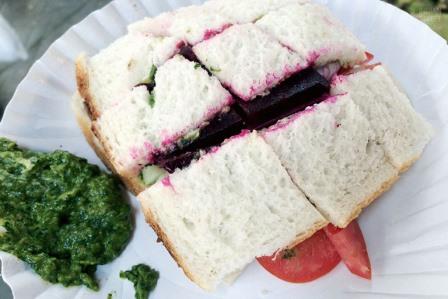
Mumbai roadside eats #1: Sandwich

This piece is for all folks who like to eat roadside stuff and all those who are missing out on the fun.
Mumbai offers plenty of choice for people who like to eat out. The great thing is that available options range from the affordable roadside eats to very expensive, exotic stuff in high end restaurants. I will focus on the roadside stuff. My love affair with roadside eats started in my early teens and continues to this day. Let’s start with the humble sandwich. Earliest recollection is of a vendor selling sandwich is one near Canara Bank in Mulund West. Technically he was not a roadside vendor as he used to do business inside a compound. What were the choices on offer? Well, at the beginning there were just 2 choices: The premium Amul butter version and the cheaper margarine version. The main ingredients for both versions were the same: Bread, butter/margarine, green chutney, cucumber, tomato, boiled potato, beet root and onion with an option to have it with tomato sauce/ketchup. For the Amul version the bread would be slightly bigger. Doesn’t sound interesting yet, right? Don’t worry let’s dive into the makings of a great sandwich. Half the fun is watching the master at work. It all starts with couple of bread slices. Out comes the knife next. Is it to just cut the vegetables? No, the bread has to be prepped first. The knife itself would be long and slender like an artist’s fingers. With four deft strokes the harder crusts on the side of the breads would be lopped off leaving the soft center ready for the sandwich creation to begin. Would the crusts be thrown away? No, the vendor would carefully collect them in a container. At the end of the day I believe they would end up as food for the dogs. The next step is spreading the butter or margarine on the bread. This would be followed by spreading spicy green chutney on the bread slices. The amount of chutney would depend on the eater’s spice quotient. The first vegetable would be cucumber. Generally the vegetables would be sliced and ready. But if you were lucky enough you would be witness to skin peeling and slicing of the vegetables. The speed and the evenness of the slices were a sight to behold. When the master was at it the sound made by the knife when it came in contact with the cutting board was like music to the ears. After the cucumber a generous sprinkling of salt and pepper would follow. Next in the line would be potato slices followed by onions, tomatoes and beets with each vegetable going over the other. After the vegetables the 2nd slice which has been waiting in anticipation would be placed over the vegetables, perfectly aligned with the other slice at the bottom. Are we ready to take a bite? No, the final act is not over yet. The magician would finally cut the sandwich into bite sized chunks. There were 2 amazing things about this final act. The first one was the fact that the resultant blocks would be perfectly intact with no unseemly tear of the bread or vegetables falling out. The 2nd amazing thing were the number of blocks itself. For the Amul version the bread would be slightly bigger and 9 bite sized blocks would be fashioned. That was like watching a feat of engineering, to watch them all nicely balanced.
Now we are ready to eat! Generally one block would be consumed at a time. The final block cannot be eaten like that. To make the taste linger you got to peel the pieces and have them individually one by one. The result: pure magic! There is also a Gujju way of eating the sandwich. The Gujju version would have the tomato sauce/ketchup splashed lavishly over the sandwich. And the Gujju bhai always managed to keep the vendor engaged in conversation while helping himself to a slice of cucumber or potato or other sundry items during the sandwich making process. After the sandwich was consumed the piece de resistance were the bonus sides: a piece of potato or cucumber with a little bit of butter and salt and pepper sprinkled over. That would complete the pleasure of eating the sandwich! One thing was certain, the eater would leave sated. Once hooked it was a certainty that you would return back again for more. Grilled versions of the sandwich were introduced later, they were a great success too! To appreciate the real worth of roadside sandwich all one had to do was go to a hotel and order a sandwich. Delivered product would be a skeletal version that would try to pass off as the real thing, with no bonus sides 😦 To a roadside eats buff the thought of germs never enters the mind, the true lover thinks that the germs would end up killing each other. For the paranoid I must say that their phobia will get to them before the germs get them 😀
Writing about the sandwich has made me hungry. I have to google and find if I can order an authentic Mumbai roadside version. I have to eat one right now 🙂

Tale of a violin

Few years ago there was quite a bit going on at work. With my restless mind worrying about projects and multiple thoughts/ideas always running in the background calm of the mind was proving to be elusive. Tossing and turning in bed at night wasn’t helping get a good sleep either. So, in an effort to calm my mind, wife suggested I learn to play the violin. The reasoning was simple: I like good music and the violin is my favorite instrument. When played well the melodious sound from that instrument has a soothing, calming effect and can move one to tears. In theory if I learned to play the instrument, practiced diligently and with focus it would calm me down and the effort would tire me enough to get sound sleep at night. Rented a violin from a local music shop around Christmas time. We had a nice violin teacher in the community where we live who is a family friend too. First class was awesome! I exceeded expectations and the sound of my playing came out confident and clear. Weekly once I had violin class. One month passed and everything went swimmingly. I decided I should go all in and bought a violin. The hard part part started shortly after that 😀 Nothing comes easy without practice. I would not practice entire week and just an hour or two before my class try to play the instrument just enough to progress further. With age learning gets slowed down and it’s difficult to teach an old dog new tricks. In my class too I would discuss music more than play the violin. Even when I tried to practice a bit was finding it difficult to get the technique right. Suffice it to say after 3 months I was still as good as new 🙂 Teacher was of course very patient and encouraging. I was getting impatient with my slow learning.
Spring arrived. One evening, to beat the rain, I decided to use the weed whacker to get rid of some wild growth in the backyard. Absentmindedly I ended up whacking my index finger which required 5-6 stitches. A bit more deeper and I could have sliced the top of my finger. Very painful but perfect excuse to stop learning 😉 The violin lay gathering dust unused and shedding tears 😦 Few months later my wife decided to learn. She practices regularly and diligently and finds happiness doing that. Of course her learning is a bit slow which is to be expected when you start late and have many other things going on. I am glad she is enjoying it. My finger has healed since and the violin has healed too from my abuses and now sports a happy look 🙂
All things considered it wasn’t a bad experience at all. I learned a few life lessons that could be useful: Having good taste doesn’t mean having good skill. Nothing comes easy, all the effortless ease one sees/hears is a result of ceaseless practice. And main lesson: If you want to do something start early, learning will be faster and mistakes won’t be very frustrating

Words of the day: Bindaas, Jhakaas!

In a nod to the city I grew up in, Bombay (or Mumbai as it is officially known now) in India, the words of the day are: Bindaas, Jhakaas!

Meaning of the words:

Bindaas: independent and carefree; admirable, cool.

Jhakaas (not to be confused with jackass 😀 ): excellent

A bit of background helps. Bombay like other great cities is a melting pot. Everything is bigger compared to the smaller towns. Business, employment opportunities, commute times, real estate price, entertainment, hustle and bustle, getting to meet folks from different backgrounds etc. People from all over the country come to the city and enrich the cultural fabric with their own language, culture and traditions. The effect of which is spawning of a culture which is a bit of everything that is also uniquely Bombayish 🙂 The city’s version of national language Hindi is also influenced by locally spoken language, Marathi, further influenced by languages spoken by people from other parts of the country. Bombayites/Mumbaikars are proud of their own lingo: Bambaiya Hindi 🙂 The original Hindi speaking people may consider calling what is spoken as Hindi a sacrilege but who cares, language is just for communication, right? 😀
Inevitably some of the Bambaiya Hindi lingo has made its way to Bollywood movies too as Bombay is home to the very popular Bollywood entertainment industry. Bindaas and jhakaas have made it to Bollywood movies too! Bindaas is generally used in a positive way to suggest something fearless yet not reckless. Jhakaas is used to convey one’s extremely positive reaction about a place, event etc.

Usage of bindaas in sentence

Person 1: क्या मैं यह करून? (Shall I do it?)
Person 2: बिंदास करो (Do it bindaas!)

Usage of Jhakaas in sentence

Person 1: फिल्म कैसे थी? (How was the movie?)
Person 2: एकदम झकास (Absolutely excellent!)

Interestingly I see bindaas has made it to Oxford English dictionary! Wouldn’t be too long before jhakaas also makes it there. Strength in numbers certainly doesn’t hurt (roughly one in seven world citizen is an Indian or of Indian origin) 😀

James Holzhauer’s life in Jeopardy! :)

It’s a been a great treat past few days for viewers of the popular trivia quiz show “Jeopardy!”. In 12 wins aired so far James Holzhauer has averaged an astonishing ~ $70K/game and has broken previous single day winning total 4 times already. To put it in context the previous record for win in one game was $77K and James’ average win/game itself is close to that amount 🙂
His strategy for winning has been quite simple actually: Start with the big $ amounts at the bottom of each category, build up a huge total, hit a daily double and bet it all/bet big, respond correctly, swell the lead to such proportions that the other contestants are forever trying to play catch up or resigned to playing for the consolation prize. Typically contestants on the show, even the winningest, have tended to start cautiously at the top or middle of each category, consolidate their lead and bet safe amounts in Final Jeopardy to ensure victory. The traditional way is akin to middle distance running: Get a decent start, gradually build a lead and then have enough for a big push down the stretch. Extending the racing analogy what James has achieved in his wins so far is the equivalent of doing a Usain Bolt over a full marathon distance, then coming back and waiting at the one mile mark to shake hands with the other two competitors still trying to make it there! This strategy to win just requires a preternatural ability to buzz in early, incredible breadth of knowledge, oodles of confidence, get almost all responses right and then have the heart of a gambler to bet big and win bigger! All that’s needed is a near perfect game and ability to replicate the strategy in each game. Very simple indeed 😀 When you witness such a display of incredible brilliance on a regular basis all you can do is shake your head in disbelief, let out a loud guffaw and tip your hat 🙂 If rumors are to be believed the producers of Jeopardy! have filed for bankruptcy in the wake of James’ incredible wins 😉 😀

Surprise! Surprise! In real life James is a professional sports gambler 🙂 He attributes some of his knowledge to reading children’s books with pictures. If his offspring/s are reading the same books I want to bet big on their winning Jeopardy! in future, breaking records. And make it a true daily double please 😀 It’s possible that the strategy could backfire, maybe even spectacularly, and James could die by the proverbial sword when the reign ends. It hasn’t happened so far and it’s time to enjoy the run as long as it lasts.

I know dream of a lot of trivia buffs out there is to take on James and beat him at his own game. The Raj lives to make such dreams come true. To get a crack at it here’s the Final Jeopardy category: 9-letter plural word describing emotional reaction

The clue: In a stunning finish resulting in defeat of the defending champion the winner witnessed ——— of delight from the viewing audience!

Put your thinking caps on for the opportunity of a lifetime with the correct response 😉

http://www.espn.com/chalk/story/_/id/26554538/inside-story-james-holzhauer-epic-jeopardy-run-where-even-alex-trebek-amazed

Silicon Valley enterprise!

A declining enterprise in Silicon Valley was in danger of losing relevance as many of their competitors marched ahead of them. Years of underwhelming performance led to low employee morale with many leaving to seek their fame and fortune elsewhere. Competitors from both coasts, Texas and even upstarts from Seattle were stealing their thunder. Determined to reverse the trend they looked for help outside even willing to entertain the idea of seeking suitors willing to buy and revive the enterprise. The old ownership gave away to Valley veterans with successful track record in VC (Venture Capital) and starting/running startups and entertainment industry. That was the first step. The task of turning around the enterprise still lay ahead. The new owners decided new, exciting talent was the first priority to revive the fortunes of the enterprise. Towards that end they got couple of very talented young men who were very creative. The youngsters did not disappoint, they were splashy and willing to take risks. Since the new talent was inexperienced it would take them a few years to mature to be at their productive best and they needed to be nurtured and tempered along the way. In short this would be a multi-year, multi-million dollar project requiring full commitment from the sponsors and product owners. The next year a passionate and talented young lad was added to the team. The young team needed someone with experience who could guide them through the ups and lows and keep them focused. For that they got a veteran of many battles. The team performance got an immediate lift and picked up
noticeably. After a few iterations realization came in that the team was still not performing to its fullest potential. Even though the team was agile, responsible and collaborating well there were errors creeping in. Analysis revealed that the guide was a strict manager and there was a communication barrier which was coming in the way.

Another search ensued and this time the person selected to guide was more of a mentor and a leader and less of a manager. This new addition also came with the advantage of having experienced success multiple times at the highest level overcoming personal tragedy and adversity along the way. This mentor was not averse to letting the team make mistakes and learn in that process. Also let the team work in their preferred style, be more communicative and take collective responsibility for resulting success or failure. The team left competitors trailing in the dust and achieved great success. However, they fell short of expectation in the next project after starting with great promise. Some soul-searching ensued with the realization the missing ingredient for more consistent success was the need for a veteran with zen-like calm and a warrior mentality without disturbing the team dynamics. Luckily one veteran, among the best in business and hungry for major success, was looking just for such an opportunity. With this new addition the enterprise that once appeared moribund turned around in a spectacular way and has been enjoying great success. Some areas of concern have appeared in recent times though. In an age where quarterly results matter a lot, the now uber-confident team has been performing with the mentality all that is needed for a successful year is a strong 3rd quarter and maintaining a reasonably high level of performance in the 4th quarter. Competition has been nipping at the heels and hubris could yet upset the apple cart even as whispers of team members wanting a greater share of credit for their role in the success have emerged.

I am, of course, referring to the Golden State Warriors 🙂

Bet you knew that already!