
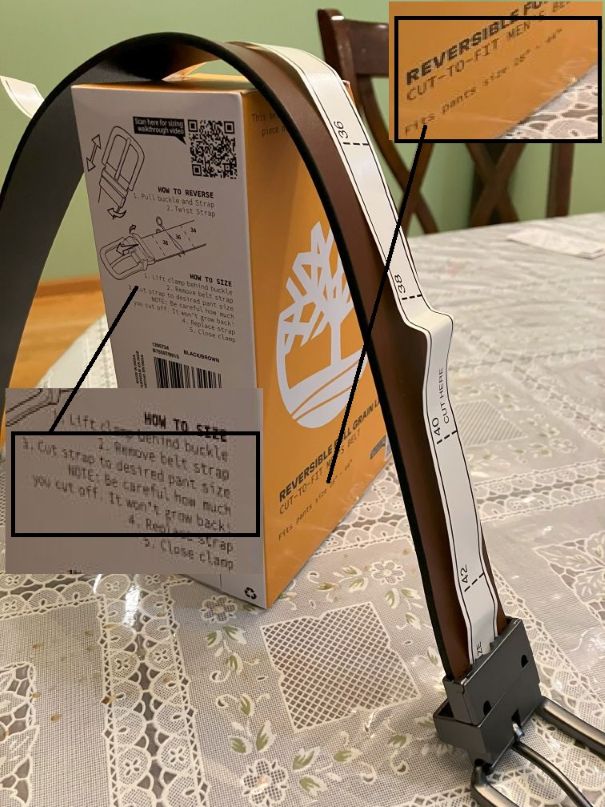
Every day there is an opportunity to learn something new. Last week I had been to Costco. I am a “lean” Costco shopper. By lean I mean I am unlike some folks who have their shopping carts filled with enough stuff to feed a village 😀 or some who seem intent on breaking Shaq’s Walmart shopping record (https://finance.yahoo.com/news/shaqs-record-breaking-walmart-spree-192117685.html) 😄 Typically I have just a few items in my shopping list and the folks at the exit appear almost somnolent and disinterested when they perfunctorily check my shopping bill . So, to avoid the Shaq-record-breaking crowd at the checkout line I have to be strategic about the day/time I go to Costco. Last week I had couple of items to shop. Grabbed a cart as one of the items was on the heavier side. As I was making my way to checkout counters I saw boxes with men’s belt. What caught my attention was “Fits pants size 28″ – 44” printed on the box. Lazy me 😊 immediately felt that perfectly suits my waist size (within the range mentioned) 👍 and personality 😂. I thought the belt will fit if my midriff shrinks (going by history that’s unlikely to happen 😆) or expands (will have to expand exponentially though to reach the max size fit 😆). As I had a cart with me, I grabbed a box of the belt. I realized I got more than I bargained for when I got home. ☹️
After showing off my purchase to my wife, I unwrapped the belt from the box to confirm the fit. It seemed longer than my other belts. As I wrapped it around my waist my first expression was “WTF 😡”. The damn belt was so long it looked more like a serpentine line for a Disney attraction 👎. To make it worse there were no holes in the belt for my waist size. ☹️ Seems like “CUT-TO-FIT” description actually means buyer has to cut the belt to fit their size if the buckle doesn’t fit any of the holes already in place. The inside part of the belt has a strip attached (with 44″ to 28″ printed on the strip) to indicate how much cutting of the belt is required for the buckle to fit the existing holes. There are 5 holes in the belt. I thought that’s probably the standard number of holes. To confirm if that’s true I examined my other belts (which generally indicate the size fit as XX – YY inches) where XX and YY are consecutive even numbers. Even those belts had 7 holes, 2 more for a narrowed range of fit. That was like an insult added to an injury. 😡 Normally I love DIY projects because there is a certain joy and sense of fulfillment when building or fixing things. In this instance I am sitting on the fence about the DIY aspect. I am miffed at myself for incorrectly interpreting “CUT-TO-FIT” meant pre-cut and miffed at Costco/Timberland for a few reasons
1) For a 16-inch range the number of holes to buckle is just incredibly low
2) To make it easier for the buyer to cut the belt they could have simply created indentations/notches on the belt itself for the waist sizes in the range. Strip costs less possibly. Using the strip provided would require the knife and precision of a professional chef to get it nice, straight and right in one stroke 😂
3) The range of waist size fits is quite simply misleading 👎. Theoretically I could create a 98″ belt, for example, and claim it would fit waist sizes 2X – 98″ provided the buyer is willing to cut the belt to required size! That would not be a false claim, but it would be misleading.
Costco/Timberland appear to have a funny side though. On the box that contains the belt one of the instructions reads “Cut strap to desired pant size. NOTE: Be careful how much you cut off. It won’t grow back!” I was rolling on the floor laughing when I read that 🤣Apparently there have been some buyers that have felt short-changed after the belt DIY exercise 😂 There you go, benefitting from my experience. 😉 I must warn you that if you tried to guess my waist size based on the range of belt size fit “Waist of mine will be a waste of your time” 😁
 TheRajBlog